Showing posts with label Diane Ravitch. Show all posts

Sunday, May 6, 2012

Christie and Cerf: CLUELESS About Public Education

I've been spending a fair amount of my time thinking and reading about the proposals Acting Commissioner Cerf has put before the State Board of Education.  To date, the changes to high school testing requirements have gotten the most press attention, and the changes to the charter school regulations have taken a back seat.  I am sure this will change in the coming weeks, and if nothing else I certainly plan on addressing the proposed changes to charter school regulations in depth.  


Before I dive in, I want to take some time to look at what the recent proposals tell us about Governor Christie and his Department of Education.

NJ Spotlight had a great overview of how the new high school testing plan was presented to the press:

Christie on Monday unveiled a plan to replace the High School Proficiency Assessment -- students get three chances to pass it, beginning in the spring of junior year -- with end-of-course exams in language arts and math at the 9th, 10th and 11th grade levels. The HSPA only measures skills at an 8th grade level, the governor said. The state may also recommend science and social studies tests.


The next day, the DOE released data showing the percentage of 2011 graduates in each district who passed the HSPA, as well as those who were exempt from taking it and those who completed an alternate assessment. Statewide, 82.2 percent of graduates had passed the HSPA, while 14.3 percent had completed the alternate assessment and 3.5 percent were exempt from testing. (emphasis mine)


Their piece included a document that showed the percentage of vocational and charter school students that pass the HSPA.  I couldn't help but notice that Camden's LEAP Academy Charter School was on the list, and was blown away by what I saw.  


Some of you may remember I spent a bit of time looking into the "success" of LEAP Academy after I testified before the Assembly Education Committee hearing in February.  LEAP students were paraded before the committee as examples of how charter schools are the best (only?) hope for the students in places like Camden, and any semblance of local control would potentially destroy the "success" of the charter school movement.


LEAP Academy's biggest claim to fame is that they graduate 100% of their senior class.  This apparently has not changed, even with the new formula which has significantly changed the graduation rates for other districts and charters.  What doesn't seem to get any attention however is that apparently only 56.9% of those students can pass the HSPA, compared with 82.2% statewide, and that the other 43.1% graduate by taking the AHSA, by appeal or "other means".


The AHSA is a more open-ended exam than the HSPA, providing more time and performance-based formats for the language arts and math tests. It was first devised in the 1980s as an exam for those who struggle with the pressures of standardized testing.
But over the years, the exam – then known as the Special Review Assessment (SRA) -- became more the norm in some districts where failing rates on the HSPA were high, and it drew increasing criticism for being too easy to pass. Specifically, some said its looser time limits and scoring, often by the students’ own teachers, had led to a test almost impossible to fail.

NJ Spotlight had another great piece about how students feel about the idea of the changes to testing requirements.  They spoke with students in West Windsor Plainsboro, where Christie announced the new testing plan.  Here is what one student had to say about the HSPA:


Question: What’s your reaction to Christie’s announcement that the HSPA would be phased out as a high school test and replaced by end-of-year exams?
Jeffrey Yu, 18, senior, WWP South: “At West Windsor Plainsboro South, there hasn’t been a year when a kid didn’t pass the HSPA. It’s an easy test for our district. For myself, I definitely thought it was pretty easy.
“I wouldn’t say it’s eighth grade [level]. It had algebra, so I would say that is more 10th grade or high 9th. But look at all the other tests we are taking, the SAT, the ACTs, AP English or math, compared to them, it’s a piece of cake.”
I love that the Governor is being schooled by students that actually understand what skills are taught at what grade levels.  But most importantly, if the AHSA is "almost impossible to fail" and the Governor thinks the HSPA only measures 8th grade proficiency, what does that say about the graduation rate claims at LEAP and the education those graduates are actually receiving?


But yesterday was less about the details and more about the politics and promises, with Christie and Cerf finally putting some flesh on their longtime claims that New Jersey’s schools don’t demand enough of their students.
“Today is about accountability,” Christie said. “We can’t go on at the level we are now, teaching to a test that is 8th grade level and telling them it is high school.” (emphasis mine)

Let's back that up a minute, Governor.  It's about accountability?  Are you for real?  


LEAP is being held up as a model of what charters can do for students, but only 56.9% of them can pass the test you say is at an 8th grade level!?!  Nonetheless, LEAP touts a 100% graduation rate and gets showered with praise from legislators, the Department of Education, and the NJ Charter Schools Association and endowed with new facilities to the tune of 12.5 million.  And not only that, they use their graduation rate as a club to beat the Camden Public Schools, the schools that actually have to try to teach the ESL and LEP students LEAP doesn't seem to serve.  


So much for accountability...


Then this morning there was an amazing opinion piece in the Asbury Park Press that nailed the problem right on the head.


Christie says too many graduates leave high school unprepared for their next step, and that these changes are aimed at correcting that.


We can’t argue with that. But the way to accomplish that isn’t by simply ratcheting up the demands and waiting to see how it all shakes out.


Raising the bar is a wonderful concept unless it’s being used primarily as a weapon to exclude more people from reaching a certain level of achievement. If Christie simply wants to chop the graduation rates down a few notches and leave more students without diplomas, that’s an irresponsible approach to reform.


Christie’s ongoing disdain for the quality of public education in New Jersey remains one of his biggest failings as governor. While there has always been some merit behind his criticisms of the teachers union, his attacks have extended far beyond legitimate gripes.


The overriding impression is that the governor would gladly replace the current system with a network of charter schools and private-tinged ventures, this despite the fact that the vast majority of the state’s school districts have been, and continue to be, highly successful. (emphasis mine)


And then there's the NJDOE's "secret proposal" that became public this week for the Camden Public School District.  It calls for the closure of ten traditional public and three charter schools.  While Christie says he has "no plans to enact the DOE scenario" the document is a clear example of Christie and Cerf's leadership style, which was perfectly explained by Diane Ravitch yesterday.

In fact, what the document shows is a Department of Education that does not know how to help public schools, that doesn’t believe in helping public schools. It shows leaders who are clueless about education. The plan begins by saying that asking how to improve the schools is the wrong question. That’s old-style thinking. 

As usual, Dr. Ravitch nails it.  The only thing the education policies and proposals of the Christie administration and Acting Commissioner Cerf's NJDOE demonstrate, including their proposed changes to high school testing requirements, is that they don't believe in actually helping public schools.  In fact, they are clueless about education.  

Thursday, February 9, 2012

LEAPing to Conclusions; Are Charters Our Only Hope, Or Only Hype?

I have been stewing about a bunch of stuff since last week's Assembly Education Committee hearing.  The local control bill was clearly the most controversial legislation being considered, and as I posted before the hearing, Carlos Perez put out a call to the charter school community to come out in force.  LEAP Academy University Charter School in Camden heeded his call and came to the hearing to testify against the legislation.  Two seniors, two graduates, (one is now an employee) and one of the founders testified.  


First off, the students looked FANTASTIC!  They were in crisp, clean uniforms and not a hair was out of place.  They looked like they stepped right out of LEAP's glossy full-color brochure (you know, the kind traditional public schools aren't allowed to print but charters can.) 


As soon as they were done delivering their testimony, they were whisked out of the hearing room.  I was shocked that the students weren't encouraged to stay for the rest of the testimony, or to see the Education Committee vote on the issue.  Apparently they weren't pulled out of school to learn more about the legislation they were testifying against or the legislative process in general.  They were there solely to deliver Carlos' their message: Vote for this bill, and you will not only kill my charter school, you will kill ALL charter schools.  There was also a fair amount of testimony from these students about how horrible the rest of the Camden schools are, much to the dismay of Camden public school parents like MoNeke Ragsdale who testified beside me on behalf of Save Ours Schools NJ.  


Apparently, the kids weren't there just to deliver their message to the Assembly Education Committee members, but also to the press.  Check out this LEAP Academy Flicker photostream that shows the students posing for photos and being interviewed.  


Here's how their Trenton trip was described on the LEAP Facebook page:


Thanks to the LEAP students, alumni and staff who went to Trenton yesterday to speak out against a new bill that could limit the charter school movement.


So, this all got me thinking.  What's going on at LEAP, and how does it exemplify why we should all just step aside and let the "charter school movement" sweep across New Jersey whether or not districts want or need them? 


LEAP's biggest claim to fame is that 100% of their students graduate and go on to college.  This was highlighted several times at the hearing.  


So what I want to know is how do they do it, is it done anywhere else in Camden, and can it work for ALL kids?  

The Brimm Medical Arts High School, a "magnet school with a comprehensive high school curriculum" comes close to matching the same statistics.  They seem to have 1 or 2 kids that chose the military or a job over college though.


So how else are Brimm and LEAP similar?  Let's take a look at their IEP, LEP and Free/Reduced Lunch numbers.  Let's look at a couple of Camden's traditional public high schools too for comparison.


Notice the difference between LEAP and Brimm and the traditional public schools?  While free/reduced lunch numbers are pretty similar (interestingly Brimm has the most Free Lunch kids) there are LOTS more LEP kids and kids with IEPs in the traditional public schools.
  
Here's what I think is happening.  In a magnet high school like Brimm there is an admissions process for students, including an entrance exam, that obviously pulls out only the smartest, most motivated students.  Charters like LEAP with a lottery system, attract only the most motivated parents, who must fill out packets of information and sign Parent Partnership Agreements.  The children of these parents are therefore more motivated, successful students.  


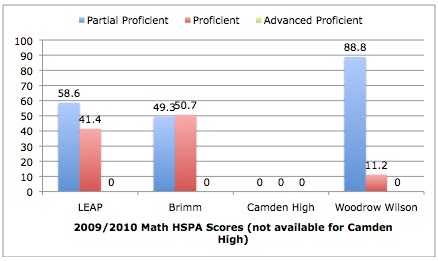
Now let's look at a measure of "success" other than post graduation plans. (by the way, this measure is self reported by the school)  Let's look at the HSPA and see if this gives us any additional information.  


So it looks like if what you're after is skimming off the most successful students AND producing higher test scores, you'd be better off opening lots of magnets, not lots of charters.  I hear you, this is only one case study.  Gee, if only Acting Commissioner Cerf would release that charter report we could look at some more data...   


This still leaves us with the problem of how best to educate the rest of our kids.  Charters like LEAP have not demonstrated that they can serve ALL students, yet they are held up as examples of what is possible if only we would loosen up our laws and allow the unchecked growth of charters.  Until they do, why should we allow the proliferation that Carlos Perez, Acting Commissioner Cerf and Governor Christie seem so desperate for?


On the way to the hearing I heard a report on NPR about efforts to raise the dropout age to 18.  Michel Martin, host of Tell Me More, interviewed a 19 year old mother that had dropped out at 16 but is back in school.  Here is a segment from that report:


MARTIN: Well, let's dig into some of this. Rashida, why don't you tell us, if you wouldn't mind, why you dropped out of school? Was it a sudden decision? Was it kind of a spur-of-the-moment thing or was it something that had been building for a while?
HARRIS: Well, school wasn't really that much important to me. I used to live at with my aunt and my brothers and sisters, we had to take care of ourselves. So, we would go to school probably two or three times a week just to be in school and walk the halls and stuff or we would go up to the school if it was a problem for us getting in fights and stuff like that. But school wasn't really that much important to me. The streets was at the time.
MARTIN: And do you mind if I ask, where's your mom in all this?
HARRIS: My mother's been dead since '96.
MARTIN: So, you lost her really early, I'm sorry.
HARRIS: Yes.
MARTIN: I'm sorry about that. And so, your aunt was taking care of you or you were living with her. She was the adult, but she didn't insist that you go?
HARRIS: Well, at the time back then I was with my aunt in the court systems and both my godmother. When I was with my aunt, she didn't really care if we went to school or not as long as we're out of her house by at least 8:30, she don't care where we was at.


This is one of my main problems with charters.  When you show me data from a charter like LEAP, and the demographics look like the rest of Camden, and the kids have the same kinds of issues as Rashida, then we can talk about the benefits of charters versus traditional public schools.  You can't compare a school with 0% LEP students to a school with 17%, and you can't compare a school where only 7% of students require an IEP to a school were 34% do. 


LEAP has some amazing support services that should be available to ALL students, but will never be funded in all traditional public schools, certainly not by Governor Christie, who is probably gearing up to slash school budgets again for 2013.  In addition to an extended learning day and a longer school year, they have an Early Learning Research Academy that begins at birth, a Parent Center, Health Center, Family Support Center and a Center for College Access.  If you follow the links you will see that many of these programs are run in conjunction with Rutgers Camden. 


But when speaking to the media LEAP doesn't attribute their "success" to the fact that they are educating a different population than the traditional schools, or even to the incredible programs available to their students.  They claim their secret sauce is a combination of their Performance Based Compensation Program, i.e. merit pay (click the link, it's their actual teacher evaluation forms!) and giving very few teachers tenure.


Rutgers professor, Chair of the Board of Trustees, and LEAP founder Dr. Gloria Bonilla-Santiago boasts that last year 10 teachers came up for tenure and only one of them got it, because the other 9 "were not good."  Is it just me, or does that sound more like LEAP doesn't want to give teachers tenure?  They were good enough to teach LEAP students for 3 years, but then when it came time to give them tenure they needed to be "exited out?"  


So let's look at how much teachers get paid at LEAP compared with the rest of Camden.  


Ouch.  That's more than $15,000 less per teacher.  


Jersey Jazzman was onto something when he questioned how much teachers get paid at charters.  Doesn't look like merit pay is working out for too many LEAP teachers, does it? Let's look at one last chart to see how much experience LEAP teachers have.


One third of the experience of the teachers in the rest of the district, and less than half of the experience of the rest of their colleagues in the State of New Jersey…


This makes me think of the speech Diane Ravitch gave at the NJEA conference.  No, I am not a teacher, but I have become enough of a freak about these issues that I trucked it to Atlantic City just to hear her, and boy was it worth it.  Look, here we are at her book signing!


She looks great, but I look ridiculous, I can't believe I'm posting this photo...


In that speech she said that the reform movement has two main goals.  One is the "deprofessionalization" of teachers.  I think Dr. Ravitch would agree that an inexperienced, low paid staff fits her definition. 


According to Dr. Ravitch the other goal is privatization.  


Soon LEAP will have a new $12.5M facility.  Wouldn't you just LOVE to know where that $12.5M is coming from?  If Brimm wanted to build a new facility the money would have to come from taxpayers, which would make it a lot harder to get the funding.  And get this, LEAP already has two new facilities!  


LEAP Academy students are educated in two contemporary-modeled learning centers: a Lower/Elementary school (grades K–6), and an Upper/High school (7–12).  A complete renovation was financed to create the Lower school in 1999, while the Upper school was built from the ground up in 2005. (emphasis mine) 


So let's review.  The only current school development project in Camden is for kids who, according to the school's hype, are already succeeding, and already have not one but "two contemporary-modeled learning centers."  But to get some much needed new schools built for the rest of the kids in Camden legislators had to pass the Urban Hope Act while the School Development Authority continues to do nothing.  Great.     


Again, let's listen to Dr. Ravitch:


I worry about the future of public education. I worry that entrepreneurs now see great opportunities to make money in the public sector and that they will exert their influence to privatize education and turn it over to the free market. I am a great admirer of the free market, but I also believe that our society needs a balance between the free market and the public sector. If public schools are privatized, it induces a consumer mentality among parents and it destroys any sense of community responsibility. It also erodes any sense of civic obligation. 


LEAP sure does look like a product for parents and students to consume.  They have glossy brochures and videos to sell their program to parents, and they have talking points that resonate with the press and reformers with deep pockets.  

But I'm not buying it, and neither should you, because what they don't have is proof that what they're doing will work for ALL of Camden's students.  Until they do, I have to respectfully disagree with Carlos Perez and the students, graduates and staff from LEAP Academy that testified last week.  We do need local control.