Friday, May 9, 2014

Charter School Growth Fund Creating New Breed Of Super CMOs

You may have noticed, dear reader, a theme running through a few news stories about the NJDOE's recently announced charter closures. Small, independent charters are being given the boot, somewhat unceremoniously and precipitously, to make way for what are essentially big box, prefab, chain Charter Management Organizations (CMOs). 

Phill Dunn from the Courier Post wrote a great piece about how Camden's City Invincible Charter School turned out to be not so invincible in the face of the CMO onslaught, and John Mooney pointed out a similar dynamic in Newark.
The Christie administration’s policies toward charter schools continued to stir debate this week, as a second school shuttered by the administration in the last month questioned whether it was being punished for – among other things -- not being part of a large charter network.
It was announced this week that the Greater Newark Charter School, opened in 2000 and one of the state’s oldest charter schools, was not approved for its five-year renewal in April, ostensibly due to low achievement levels and a lack of plans to remedy them. 
But its director said yesterday that the school is appealing the decision, contending that the state Department of Education did not follow its usual protocol in reviewing the school.
Christopher Pringle, the school’s director, said the school had fallen below set benchmarks in a single area for the first time in its 14 years. He questioned if the state was favoring schools that were part of large charter networks over the smaller independent schools. 
(emphasis mine)
 Even Carlos Perez of the New Jersey Charter Schools Association seems a bit concerned.
The executive director of the state’s charter school association said the issues point to the changing face of the charter movement in New Jersey. 
“New Jersey has had a unique history, in that in most other states, there has been more a mix, while in New Jersey, there were very fewer (charter management organizations),” said Carlos Perez of the New Jersey Charter Schools Association. 
“Now, that’s changing, and while it may seem like major growth, it’s really us just catching up with other states.” 
Perez said he hopes that the smaller, independent charters will continue to thrive. 
“They have been the life-blood of the movement,” he said. “And after all, the big organizations all started as smaller ones in the beginning.” (emphasis mine)
While Perez may "hope" the mom and pop charters of yesteryear live on in New Jersey, if I were him I wouldn't hold my breath. And I disagree that the growth of CMOs in New Jersey is "really us just catching up" with the rest of the country. 

There is a well connected, well funded effort underway, and it seems that not even a change in Commissioner can stop the train that Cerf and his cronies have set in motion.

NACSA's One Million Lives Campaign


Remember way back in December of 2012, when I wrote about the One Million Lives campaign?

One Million Lives press conference
with Cerf and Richmond
In case you missed it, here is all you really need to know summed up in a single sentence from the One Million Lives press release.
NACSA today launched its “One Million Lives” advocacy campaign, designed to provide better schools to one million children by opening more good charter schools and closing more failing charter schools.
You don't have to read too far behind the rhetoric to figure out that the ultimate goal is to close a bunch of "failing" (read small independent) charters in order to open a whole bunch of "good" (read big CMO) charters.

Who spearheaded the One Million Lives campaign, you may ask? Why, that would be none other than ex Commissioner Cerf, and his pal Greg Richmond, President and CEO of the National Association of Charter School Authorizers (NACSA). 
Profits over children

You see New Jersey, these guys are much smarter than you. You may have been sold on the idea of charters as small laboratories of innovation, but Cerf and Richmond have much, much different ideas. 

And their ideas are about to come to life in New Jersey, with a little help from people with much, much more money than you'll ever see if your lifetime.

The Charter School Growth Fund


It is going to take some minds much greater than mine to figure this out completely, but let's get the story rolling while I look for some clever people who understand finance and numbers to help me completely unpack this. 

Here's what I know so far.

The Charter School Growth Fund (CSGF) is all about expanding CMOs across the country.
The Charter School Growth Fund (“CSGF”) is a non-profit fund working to transform K-12 education by investing in innovative charter school networks that offer outstanding educational options for under-served students. Founded in 2005, our mission is to invest philanthropic capital in the nation’s highest performing charter school operators to dramatically expand their impact on low-income and minority students. We provide financing, business planning support, coaching and other resources that portfolio members require to build networks of high-performing schools. (emphasis mine)
Invest philanthropic capital... dramatically expand impact... build networks of high-performing schools...

I don't know about you, but I'm stuck on the word invest. This is from the CSGF website, under "Why Invest?".
CMOs have demonstrated the ability to scale effective school models in a way that is unprecedented in U.S. education. During the scale-up phase, however, philanthropic investment in CMOs addresses a critical financing need. It addresses the central operating deficit between when a CMO staffs up to undertake an expansion campaign and when the central office breaks even on management fees from schools in the network.  This philanthropic contribution is temporary, however, because management fees come out of public revenuesan income stream that should sustain network operations at full scale. (emphasis mine)

Somewhere in this spiel about "market share" and "expansion campaigns" lies the fact that CSGF gives CMOs a leg up over the little guys when they "invest in the scale up of 40 to 45 of the highest performing and most promising CMOs across the country."

So who has heeded the call and invested in CSGF?

All the folks you'd assume - Broad, Gates, Walton and a whole host of others (click the link above - the list is extensive). 

In fact, Walton heir Carrie Walton Penner, recently described as an "uber education policy wonk", is married to the co-chair of CSGF, Greg Penner.

According to CSGFs 2012 990, CSGF reported a mind blowing $180,609,418 in assets.  

In the same year the Walton Family Foundation gave a $10,000,000 "contribution", there was a $650,000 "donation of Wal-Mart stock", and CSGF was still paying off a $10,000,000 Walton Family Foundation loan made in 2007, accruing "3% interest per annum".  

There are loans from Broad and Gates that are also accruing interest.

The 2011 990 reflects a mere $139,397,825 in assets, but Walton "contributed" a whopping $32,715,000 that year.

There is some serious money flowing through the CSGF.


The National Impact


It should come as no surprise that CSGF and NACSA have teamed up to directly lobby legislatures in states like New Jersey to expand CMOs and close "failing" (again, read small, independent) charters. Here you can read their full, joint report, titled Replicating Quality: Policy Recommendations to Support the Replication and Growth of High-Performing Charter Schools and Networks”.

From the press release:
State policies must change to differentiate and grow high-performing charter schools and weed out the low performers according to a report released today by the National Association of Charter School Authorizers (NACSA) and the Charter School Growth Fund (CSGF). (emphasis mine)
It looks like City Invincible and Greater Newark have been "weeded out" to make way for bigger, better CMOs.

If legislators have any doubts that NACSA and CSGF are indeed right, and bigger IS better, Stanford University’s Center for Research on Education Outcomes (CREDO) has written up a study which conveniently concludes that CMOs receiving CSGF money are the best and the brightest! (I've written about CREDOs credibility problems here, here and here.)

Few observable attributes of CMOs provide reliable signals of performance. We sought to identify attributes of CMOs that were associated with the overall quality of their portfolio. For the most part, most of the factors we examined had no value as external signals of CMO performance. Specifically, there is no evidence to suggest that maturity, size (by either number of schools or total enrollment) or the spatial proximity of the schools in the network have any significant relationship to the overall quality of the CMO portfolio. Operating in multiple states dampened a SMO's results on average. One bright signal was found in having a CMO be the recipient of a Charter School Growth Fund; those CMOs that were supported by the Charter School Growth Fund had significantly higher learning gains than other CMOs or independent charter schools.(emphasis mine)
Well, there you have it! CREDO says they can't really put their finger on anything in particular that makes a CMO better than an independent charter, but if the CSGF dumps a bunch of money in they perform better than other CMOs or mom and pop charters.

I guess that means more market share for CSGF CMOs, huh? 

How convenient.

The New Jersey Impact


So let's take a look at the CMOs that are moving and shaking in New Jersey.

Uncommon Schools, which runs the 9 North Star Academy charters in Newark, (as well as charters in Boston, New York City, Rochester and Troy, NY) has some pretty big plans for Camden.
Uncommon has proposed to launch 5 schools in Camden, ultimately serving grades K-12 and beginning with one elementary school serving Kindergarten in Fall 2014.
TEAM, currently a network of 6 KIPP schools in Newark, is looking to open 5 charters in Camden as well.
Not only are networks like Uncommon and TEAM spreading from Newark to Camden, but other CMOs are crossing state lines to set up shop in New Jersey.


And then there is Touchstone Education. Initially approved to open charters in Newark and Trenton, Touchstone opened only Merit Prep Newark in September of 2012. Before they have even proven themselves they have asked the state for another location in Newark.

What, if anything, do the CMOs that are spreading like a virus have in common?

You guessed it. CSGF is "investing" in each and every one of them.

Uncommon
Planned Impact:

In 2013, CSGF made a second investment in Uncommon Schools to support the growth of 11 schools and USI’s creation of 4,493 new seats. USI will eventually have 45 schools serving over 18,000 students.

TEAM
Planned Impact:

At full capacity in 2013, five TEAM schools will form a full pre-K–12 system serving more than 2,200 students or over five percent of Newark public school students.

Mastery
Planned Impact:

Mastery plans to expand 20 schools serving 12,000 students in 
Philadelphia.


Ascend 
Planned Impact:

Ascend plans on growing from six schools today to 17 schools in 2018, when the network will serve 8,500 students.

Touchstone
Planned Impact:
During the first phase of Touchstone’s growth, it plans to launch six schools in New Jersey that will ultimately create over 3,600 new seats of student capacity in blended learning secondary schools. Touchstone hopes to develop the next evolution of the “no excuses” school, where students’ progress on unique learning paths based on their specific needs with the expectation that all students exit prepared for college.

Protected From Up On High


Seems pretty clear, that if your CMO has been anointed by the CSGF and their myriad investors, your schools not only have a better chance of surviving, but of attaining and maintaining "market share" in one or more cities.

Over the coming weeks and months I will be following the rise (and fall) of some of these CMOs gaining traction in New Jersey, and I will be looking more in depth at CSGF and their sphere of influence.

I hope you'll stay tuned.

Thursday, May 8, 2014

Education Reform Now Dumps $2.1M Into Newark Super PAC To Defeat Ras Baraka

Just yesterday the Star Ledger reported on the intriguing campaign finance issues swirling around the Newark mayoral race.
On the other side of the city, Baraka charged that Jeffries was hiding the identity of his donors through an independent expenditure group — Newark First — which records show has raised more than $1.3 million from a handful of donors, including an $850,000 contribution from Education Reform Now, a politically active education reform organization. (emphasis mine)
But it looks like they may not have dug deep enough.

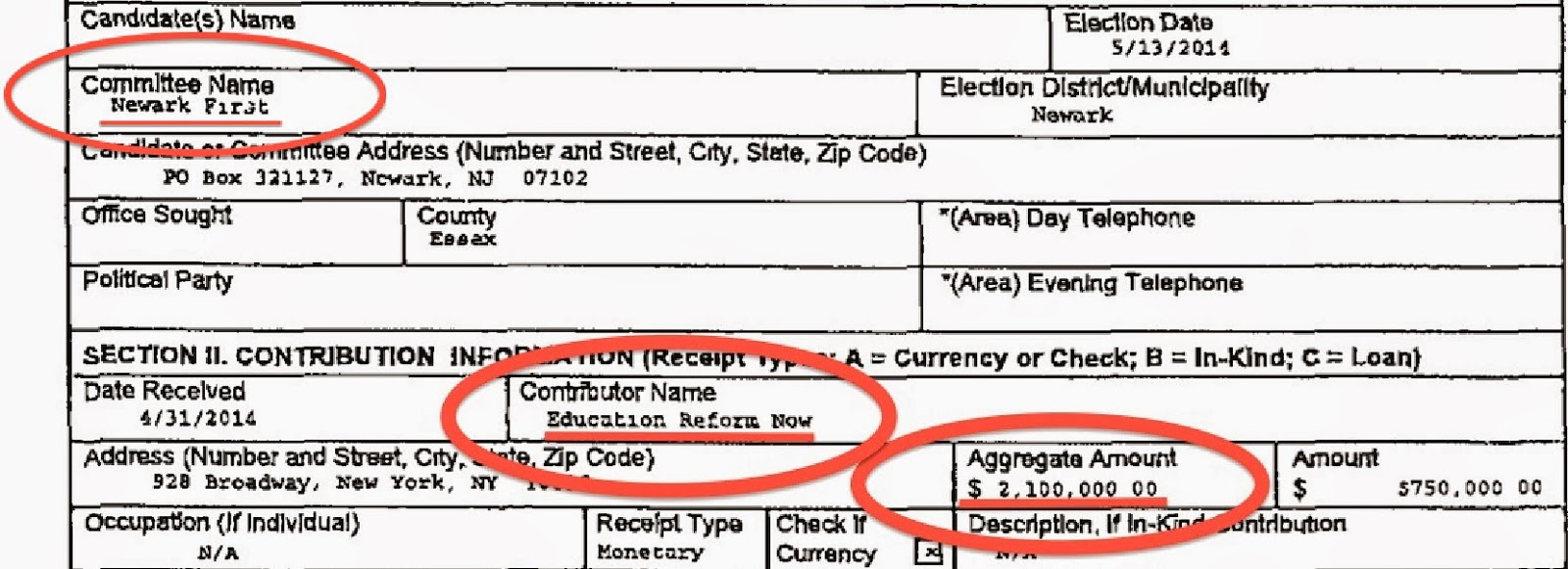
According to ELEC filings, between April 11, 2014 and May 1, 2014, DFER aligned Education Reform Now, has poured over $2 million dollars into the Super PAC Newark First. 

As I wrote yesterday, on April 11th (the same day the money started rolling in) Joe Williams, Education Reform Now President and DFER Executive Director, sent out a rallying cry for Jeffries.
Joe Williams made his pitch on the DFER website on April 11th, touting Jeffries' "reform cred."
Raised by his grandma in Newark’s South Ward, Shavar has dedicated his career to helping kids as president of the city’s Boys and Girls Club, head of Newark’s School Advisory Board, and founding board president of TEAM Academy Charter. Yet despite his reform cred, he remains in a close race leading up to the May 13th election. His opponent, Ras Baraka, promises to undo progress made during Cory Booker’s tenure, and has $ pouring in from the Newark Teachers Union endorsing his campaign. Donate just $10 to Shavar by clicking here. (emphasis mine)
Looks like they were able to shake loose a little more than $10. $2,099,990 more to be exact.


The $2.1 million from Education Reform Now is certainly the largest donation to Newark First, but it's just the tip of the iceberg in terms of the hedge fund/investment bank/education reform juggernaut that has been unleashed in this mayoral race.

Jenna, John, Christy and Stephen Mack
The Mack family alone, lead by ex Morgan Stanley CEO and current Cuomo advisor John Mack, has donated $172,000 to Newark First. Multiple donations have come in from Jenna, Stephen and John Mack, ranging from as little as $5,000 to as much as $126,000, between March 27,2014 and April 25, 2014.

Lee Ainslie, CEO of Dallas, TX hedge fund Maverick Capital, kicked in another $26,000, bringing the total contributions from the financial sector to Newark First to $198,000

And this is just the money that went into the Super PAC! What about the money donated directly to the Jeffries campaign?

By my estimation, combing through all the ELEC filings to date, education reformers and Wall Street whizzes have ponied up another $800,000+ directly to Jeffries.

Behold:


Combing through the list is fascinating, a veritable Who's Who of Ed Reform and Wall Street. Even Michael Bloomberg threw in $15,000! Notice the Mack family has donated directly to Jeffries' campaign as well, another $26,000 a piece for John and his wife Christy, which brings the Mack family total to an even $250,000. A nice, round quarter million dollars.

DFER made a direct $14,000 contribution to the campaign in late March, and both Joe Williams and Whitney Tilson made small personal contributions of $500 each. Ed Reform superstar and DFER co-founder Boykin Curry makes an appearance with $26,000, as does Booker supporter and hedge fund manager Bill Ackman. Contributions from Ackman, his wife, and others from his Pershing Square Capital Management total over $100,000.

The Doris and Donald Fisher Fund ($26,000) and MCJ Amelior Foundation ($75,000 total from Raymond, Patricia and Christine Chambers), were both early donors to the Newark Charter School Fund.

Donors hail from San Francisco and Palo Alto, CA; Baltimore, MD; Rye and New York, NY; and Montclair and Morristown NJ, but not a single one of these big money donors actually lives or works in Newark. 

The reform and hedge fund donations to the Newark First Super PAC and those made directly to the Jeffries campaign, create a $3.1 million dollar war chest to defeat Ras Baraka. 

(I say this with the caveat that this figure is just me pouring over ELEC filings, so there are donations I surely missed and who knows how much more has come in since the last reports were filed.)

The real question is, what does $3.1 million dollars buy these plutocrats?

Bob Braun has it just about right on that one.
They are all rich, hedge-fund managers who have absolutely nothing in common with the people of Newark–but they are providing the money to buy themselves a mayor and to ensure Cami Anderson imposes her plan to destroy neighborhood public schools.
The more charters there are in Newark, the more money hemorrhages out of Newark, and back into the pockets of Wall Street. The $3.1 million is an investment. An investment to ensure that the money keeps flowing. 

Baraka is the tourniquet the neighborhood public schools need, to secure the funding in the schools where the students need it the most. 

Don't let the hedge-fund managers and ed reformers buy the destruction of public education in Newark. 

Wednesday, May 7, 2014

DFER Trying To Steal Election From Ras Baraka

The Newark mayoral race is heating up with less than a week to go, and there has been plenty of discussion about an influx of cash to the Jeffries campaign and questions as to where the money is coming from.
Newark First, an independent group of Jeffries' supporters, launched an advertising campaign Wednesday attacking Baraka's record of managing city finances. 
"Who will move Newark in a new direction? Not councilman Ras Baraka," the narrator said. "Jeffries is a different kind of leader. 
The group has raised more than $1.3 million. Its donors include several financial executives and an $850,000 donation from Education Reform Now, a politically active education reform organization, according to its election filing report. 
Newark First has spent almost $425,000 on the election, the report says. (emphasis mine)
Wow! 850,000 from Education Reform Now!! What's that?

Why, inquisitive reader, that would be a 501c3 affiliated with none other than Democrats for Education Reform. You see, Education Reform Now's President just so happens to be DFER Executive Director Joe Williams. Williams is also President of a related 501c4, Education Reform Now Advocacy. 

And in case you're not up on DFER, I'll let DFER Watch fill you in on exactly who they are and what they stand for.
Democrats for Education Reform is a political action committee supported largely by hedge fund managers favoring charter schools, merit-pay tied to test scores, high-stakes testing, school choice (including vouchers and tuition tax credits in some cases), mayoral control, and alternative teacher preparation programs.
2009 tax documents reveal the direct relationship between DFER, Education Reform Now, and Education Reform Now Advocacy.


The same documents reveal a direct connection between Education Reform Now, Students First and Students for Education Reform (SFER).


Across the Hudson in New York the connections between Students First, DFER and Education Reform Now have been no secret. 
The future of the fight over public schools has a fresh, highly visible face, and it’s called StudentsFirstNY.
But the new school-reform supergroup, founded by former New York City Schools Chancellor Joel Klein and ex-D.C. schools chief Michelle Rhee, is in fact not that new at all. It builds directly one of the biggest lobbying forces in New York State, called Education Reform Now.
In the last two years, Education Reform Now and the associated Education Reform Now Advocacy have spent more than $10 million to influence state law on hiring and firing of teachers, as a counterforce to the state’s two major teachers’ unions.
.....
Last week, Education Reform Now’s sibling political group, Democrats for Education Reform,  announced that it will be joining forces with StudentsFirstNY as part of a new statewide coalition, to be known as the New York State Education Reform Council.
“We’re going up against one of the most powerful interests in Albany,” said Joe Williams, who directs both Education Reform Now and Democrats for Education Reform, to the New York Post. “We don’t stand a chance if we’re not aligned and focused.” (emphasis mine)
Read the whole article linked above from The New York World, it is a real eye opener for sure. It draws clear lines between the money flowing into these groups and their education reform agenda in New York and across the nation.
Williams told The New York World that Klein’s new group and his old one will likely share some of their funders and board members. “I imagine there will be a large overlap among the donors,” he said. “But it’s not clear yet what role we’ll actually play.”
Education Reform Now does not disclose its donors, but among those who have publicized contributions are the Bill and Melinda Gates, Walton, Starr, Broad and Pershing Square foundations. (emphasis mine)
So if New York is any indication, the money flowing into the Jeffries campaign is a combination of Wall Street money and Broad, Walton, Gates etal. money. 

I know, a real shocker, right?

But in case you're still not convinced, check out the timing of these direct pleas for contributions.

Joe Williams made his pitch on the DFER website on April 11th, touting Jeffries' "reform cred."
Raised by his grandma in Newark’s South Ward, Shavar has dedicated his career to helping kids as president of the city’s Boys and Girls Club, head of Newark’s School Advisory Board, and founding board president of TEAM Academy Charter. Yet despite his reform cred, he remains in a close race leading up to the May 13th election. His opponent, Ras Baraka, promises to undo progress made during Cory Booker’s tenure, and has $ pouring in from the Newark Teachers Union endorsing his campaign. Donate just $10 to Shavar by clicking here.
Six days later on April 17th DFER Board member Whitney Tilson made a similar plea, and called Jeffries "a courageous reformer."
But to win, he needs a lot of money fast, as the election is less than two months away, so I hope you’ll join me in supporting him – just click here: http://bit.ly/1lLB7Sb 
(emphasis mine)
When Joe Williams and Whitney Tilson put out the call, it's not hard to imagine that millions come rolling in very quickly.

Lo and behold, on April 21st reports began surfacing that $1.3 million had been dumped into the Jeffries war chest by "super PAC, Newark First."
Contributors included several financial executives and Education Reform Now, a New York City-based group begun by financial fund managers who support charter schools. The organization has spent $444,000 on TV ads and field organizing to back Mr. Jeffries, the filing shows.
In case you're thinking the claim in the graphic above from the Baraka campaign that the "shadowy group" behind Newark First is trying to "buy control of Newark's government" is far fetched, perhaps a final look at Education Reform Now's two biggest expenditures in 2012, as reported on their 990, will convince you that it's not.


Almost $5 million to "increase the number of public charter school [sic] and strengthen teacher evaluation procedures" and half a million to try to shut up Chicago Teachers Union President Karen Lewis. (Good luck with that one guys!)

Education Reform Now has a very clear anti union, pro reform agenda, which fits in just perfectly with Governor Christie and Superintendent Cami Anderson's One Newark plan, and they are attempting to steal the Newark mayoral race from Ras Baraka. Baraka has made it clear that he will lead a "full scale campaign for local control of schools" which will not bode well for the continued state takeover in Newark or One Newark.
Governor Christie is clear in his disdain and disregard for the citizens of Newark. He did say, "We run the school district in Newark, not them." He has disenfranchised the people of Newark by installing leadership at every level that believes this as deeply as he does and goes to every end to exclude, marginalize, and eliminate anyone who does not(emphasis mine)
And it looks like Governor Christie and Cami Anderson have found an ally in DFER and Education Reform Now for eliminating Ras Baraka.

Don't let them win, Newark.

Chose Ras.


Sunday, April 13, 2014

Failed Los Angeles 'Education Entrepreneur' Tries To Make A New Start In New Jersey

The latest round of charter applications have been announced, and as NJ Spotlight's John Mooney points out, New Jersey charters have become entirely an urban affair, with an ever increasing number of state and national Charter Management Organizations (CMOs) throwing their hats into the ring.

It hasn't escaped Mooney that this is a whole lot of applications - 40 to be precise - even though the last round of 38 yielded only three approvals. Let's hope a change of Commissioner doesn't bring a return to the early days of the Christie administration when 23 applications were approved in a single round.

As I peruse the list of applications, and compare it with the last years circus-like spring applications, this round is not nearly as controversial. There is no Pastor McDuffie laying hands on the Governor and no return of former Assemblyman and Washington Township Mayor Gerald Luongo, who served time in federal prison for diverting campaign funds and charity money into his own pockets. 

While this year's applications may not be full on Big Top material, there is one that caught my attention in the last application cycle, and has come back for a second try.

College Achieve Central Charter School


Mooney listed the application submitted by College Achieve as one of many "larger education management organizations," but College Achieve does not have a single operating charter school in New Jersey, or any other state for that matter.

In fact, College Achieve applied for a charter for the first time in 2013. But I will concede that the lead founder on the application, Mike Piscal, has been around the charter block a time or two, and has been involved with other CMOs.

Mike Piscal in Los Angeles


Piscal has Jersey roots, but his greatest claim to fame came in Los Angeles. His first gig in LA was at the prestigious Harvard-Westlake School, "the destination for many children of L.A.'s business and entertainment elite."  

According to Caitlin Flanagan, one of Piscal's colleagues from Harvard-Westlake, Piscal was convinced he could recreate the education experiences of the children of LA's elite for the children in the toughest neighborhoods of South Central LA. A laudable goal, for certain.
I viewed the subject of American public education as complex; he saw it as simple. It would have been an endless conversation between two friends if he hadn't taken matters out of the realm of the theoretical. He quit his job, put $40,000 of debt on his credit card and started something called the Inner City Education Foundation, which has become one of those charter school miracles that makes you question everything you've ever believed about the intractable nature of poverty in urban America.
Inner City Education Foundation (ICEF) charters have been held up as miracle schools that close the achievement gap and send almost all kids to college, and Piscal has been heralded as an altruistic miracle worker with a big heart.
Consisting of 15 schools in a once academically blighted area of south Los Angeles and with an 88% African American enrollment, ICEF has done what we are always told is impossible. All five of its elementary schools have eliminated the achievement gap in reading for its African American students. Eliminated it. That fact alone should cause the Department of Education to send a team of researchers to ICEF this afternoon and to keep them there until they learn what Mike's doing.
This Good Morning America segment about Piscal/ICEF demonstrates just how hard this supposed LA miracle story was being sold on the national stage.


@ 4:55 - Mike Piscal: We can't fail - no matter how tough the times are - they might slow us down a little bit, but we can't fail.
But sadly for Piscal, as we've seen time and time again, miracle schools not only can fail, they often do, usually because they were never truly miraculous to begin with.

In September of 2010, after reading Flanagan's Piscal/ICEF love fest, Aaron Pallas, Professor of Sociology and Education at Teachers College, Columbia University, who also happened to be a statistician at the National Center for Education Statistics in the U.S. Department of Education, thoroughly debunked the ICEF miracle school claim.
I’ll admit it: When I hear the phrase “charter school miracle,” my antennae go up. It’s not that I think that charter schools can’t possibly be good schools, or that they cannot surpass traditional public schools in the measured achievements of their students. The evidence is pretty clear that there are many fine charter schools, just as there are many struggling charter schools.
No, it’s that I think miracles are exceedingly rare phenomena. And the current narrative about miracles in school reform relies heavily on a “great man” theory, replete with outsized personalities.
.....
But no one looking at this figure would conclude that the ICEF elementary schools have come close to eliminating the achievement gap that separates the test scores of African-American and Latino children from white children in Los Angeles. Test scores are, to be sure, a very narrow representation of what children are learning in school, and I would never want to base a judgment about the quality of ICEF schools, or any other schools for that matter, solely on test scores. But Flanagan flew the achievement-gap flag, and her claims don’t hold up under scrutiny.
I like a good story as much as the next guy. But when it comes to swaying opinion on important matters of public policy, we should demand more. Perhaps Caitlin Flanagan has access to other data that provide more support for her claim that all five of the ICEF elementary schools have eliminated the black-white achievement gap in reading. But until she goes beyond a bald, unsupported assertion, she’s got a credibility gap. (emphasis mine)
In the very same month Pallas wrote this piece it became very clear that not only were ICEF schools not the miracles they were portrayed to be, there were very real problems at ICEF that threatened their very existence. The downward spiral was chronicled by Los Angeles Times writer Howard Blume. 
A group of the city's leading philanthropists, including billionaire Eli Broad and former mayor Richard Riordan, rallied Monday to save ICEF Public Schools, one of the nation's largest and most successful charter school companies, which was teetering on financial insolvency.
ICEF, which operates 15 schools in low-income minority neighborhoods of Los Angeles, was virtually out of cash, unlikely to meet its Oct. 1 payroll. The nonprofit faced a $2-million deficit in the current budget year as well as substantial long-term debt.
The collapse of ICEF would have been a blow to the charter movement and to the 4,500 students and several hundred employees of an organization whose results have impressed many observers. Charters are independently run public schools that are free from many regulations that govern traditional schools.
ICEF representatives and others said the group's budget problems were caused by insufficient reserves; an overly ambitious expansion — 11 new schools in three years — that resulted in costly debt; and a reluctance to make cuts affecting students. These factors were exacerbated by the recession, which sharply reduced state funding to schools, and this year's late state budget, which has delayed payments to schools.
The rescue plan that emerged Monday was less disruptive than one under discussion as recently as Sunday. That plan would have broken up ICEF, distributed schools and students among other charter schools and forced out founder Mike Piscal.
Instead, Piscal will remain to oversee academic programs.(emphasis mine)
Well, so much for Piscal's theory that ICEF was infallible. 

Another report detailed the extent of ICEF's financial troubles.
Young said there was no evidence of malfeasance but substantial bad judgment and a lack of transparency with ICEF’s finances.
....
ICEF’s board of trustees sensed there were financial problems and hired an accounting firm last winter, but was given only an oral report and not fully aware of the severity of the problems, Young said. The telltale sign was that ICEF ended up borrowing against state revenues beyond the current year – “a terrible idea,” she said. (emphasis mine) 
Kind of sounds like Piscal was less than forthright about the downward spiral ICEF was in, and the ICEF board had to unearth the dysfunction for themselves.

And while it may have appeared for a short time that Piscal was going to ride out the storm, he ultimately resigned, and it became clear that ICEF's troubles were not just financial. 

School Board member Steve Zimmer stated LAUSD would not pledge financial assistance until ICEF "serves more disabled students and English learners." Parents complained that ICEF's operations were "too secretive" and employees reported there were supply shortages and they were asked to work extra time without compensation.

The bottom line - Piscal had to leave a charter chain he built up and then ran into the ground, and without a bailout from Eli Broad and others, it would have gone belly up completely. 


Mike Piscal in Las Vegas


Piscal's chartering days were far from over. He made his way to Las Vegas, where in his infinite wisdom Andre Agassi made Piscal the Executive Director of his controversial charter school. 

Agassi has big plans; Diane Ravitch has reported that Agassi has amassed 750 million to create a chain of charters nationwide. This despite a laundry list of scandals at Agassi's Vegas charter, from troubling allegations of excessive teacher and administrative turnover, to more run of the mill cheating accusations to unbelievable charges that a teacher was the leader of a prostitution ring.


Mike Piscal in New Jersey


It's unclear when or why Piscal cashed in his chips and left Vegas, but as recently as May of 2013 he was still reportedly running the show at Agassi Prep but in October of 2013 he applied to open College Achieve in New Jersey.

While the application made it through the first round, it was ultimately denied, much to the chagrin of Piscal, who posted a letter to prospective parents on the website he started for the fledgling charter.
Dear Parents of Plainfield,

We received notice from the New Jersey Department of Education (NJDOE) that our application to open a charter school in September 2014 was denied.  As difficult as this is to believe, we have explored the appeal option and decided that it is not viable.  As much as we disagree with the NJDOE's decision, we must respect the process. 

This does not mean we are giving up.  In our meetings with you, formally at the Plainfield library, and informally as we have canvassed the entire city, we have heard over and over again that Plainfield parents want more choice, and that your children need more options.  Inspired by this, we are reapplying on March 31, 2014 for a September 2015 opening.  We will find out September 30th, 2014 if we have been approved for September 2015.  

Please feel free to e-mail me or Rachelle Nelson, our founding principal, with any questions you have or to express support for our application at mpiscal@collegeachieve.org or rnelson@collegeachieve.org. 

Sincerely,


Michael Piscal
Founder
College Achieve Central Charter School
Perusing the website is telling. 

Piscal relies heavily on his time at ICEF to sell the idea that he has the right stuff to open a charter in New Jersey. There are pictures of Piscal with Magic Johnson, and links to glowing stories of ICEF's miracle school status.  
Well, if he knows Magic Johnson he should be a shoo-in
to get a charter, right?

But of course there is no reference to or mention of the financial upheaval at ICEF which lead to his ouster.

In my research into Piscal's history and new venture I found some very interesting documents, including the incorporation papers for his new non-profit. The document reveals not only that Piscal is not going into the next chapter in his career alone, but that he's brought the central cast of characters from ICEF along for the cross-country ride.


Piscal's Partners in.... charters


Listed on the incorporation papers are the names of three individuals who will be the "initial board of trustees." Two of the three are John J. Piscal and Stephen C. Smith. 


Not hard to guess that John Piscal is related to Mike Piscal. What you have to dig around to find out though is that John worked for Mike at ICEF. In fact, he was the CFO from 2001 to 2007, and later served as the "Chief Development Officer."

In 2008, John stepped into the role of Chief Development Officer tasked with the role of developing new streams of income from private and public sources; developing an annual fundraising campaign that equals no less than 5% of ICEF’s annual budget; and launching an endowment drive of $30 million. 
Remember that ICEF's rapid expansion, dwindling reserves, and a decline in philanthropic investment were central to their financial failings. Mike's brother John sure seems to have helped steer the ICEF ship into the financial iceberg that eventually sank it. 

And who is Stephen C. Smith? 

This is where it starts to get really interesting. Smith is a co-founder of the Seaport Group, a "boutique investment bank." Smith also just so happened to be the Chairman of the Board of ICEF. Smith is still listed as a "supporter" of ICEF on their website, having "donated" over $500,000, but ICEF's 2010 990 seems to indicate the money was less of a gift and more of a loan.

Almost 1 million from Smith, 3 million from former LA Mayor Riordan (who is now 
Chairman of the ICEF Board), and 120,000 from another Piscal relative.

Seems maybe Smith, then Chairman of the Board, knew the financial mess ICEF was in, and wasn't willing to throw money in without making sure he was going to be able to get it back out.

For his efforts Smith was showered with gratitude at a "star studded gala" to raise funds for ICEF and Success Through the Arts Foundation, which was co-founded by Jackson Browne, who is also on the ICEF Board.
"No single artist has done more for arts education and public education in general for more years than Jackson Browne," say Michael Piscal, ICEF's co-founder and CEO, and Fernando Pullum, board member of Success Through the Arts Foundation.
"Stephen Smith has helped pioneer and fund an education revolution and in the process gave birth to the 'education entrepreneur'," the duo added. (emphasis mine)
Well, good to know we have Smith to thank for the birth of the 'education entrepreneur', isn't it?

College Achieve is the brainchild of the three men at the heart of the financial downfall of ICEF, Mike and John Piscal, and Stephen Smith, and the combined resumes of these three gentlemen certainly leads me to believe that College Achieve is far more of a business venture than an educational endeavor. 

And while Smith may be willing to help finance the re-birth of Piscal in New Jersey as an 'education entrepreneur' after his fall from grace in Los Angeles, I'm not sure the taxpayers of New Jersey will be so willing to forgive and forget now that they know the cold, hard facts about their checkered pasts.